Forget “Quitter’s Day.” The goal isn’t to be perfect, it’s to keep going.
- Team Fitify
- 09 Jan 2026

Quitter’s Day” isn’t a verdict — it’s a checkpoint. Fitify’s anonymized January data (5 years) shows a simple pattern: starting with a structured plan is linked to ~1.8× higher follow-through after Jan 21, and smaller, realistic goals tend to stick better than big leaps. Here’s how to reset without shame.
The internet has a name for today: “Quitter’s Day” — often described as the point when people abandon New Year’s resolutions. We get why it spreads: it’s catchy, it feels true, and it gives everyone a neat little story.
But here’s our take at Fitify: the label is the problem. Calling it “Quitter’s Day” turns a normal part of behavior change into a moral failure. And that’s exactly what makes people stop.
So instead of treating today like a verdict, treat it like a checkpoint:
- Did you go too hard, too fast?
- Did your plan rely on motivation?
- Did you set a goal that sounded exciting… but wasn’t sustainable?
If any of that is true, you didn’t fail. You just need a better setup.
The junk science of January (and what actually works)
January is full of confident-sounding claims. Two of the biggest ones are actively unhelpful:
Myth #1: “It only takes 21 days to build a habit.”
That’s not how habit formation works. Research following real people building real habits found huge variation — from ~18 to 254 days, with an average around 66 days to reach a stable “automatic” pattern.
Translation: if your routine isn’t effortless after a couple of weeks, that’s normal. You’re not broken. The timeline was.
Myth #2: “If you miss a day, you’ve ruined it.”
Missing workouts isn’t a character flaw — it’s life. Travel, sickness, deadlines, kids, weather, stress… the goal isn’t to never miss. The goal is to make returning easy enough that you actually do.
If your plan only works when everything goes perfectly, it’s not a plan. It’s wishful thinking.
What our data says: structure beats willpower
We looked at anonymized, aggregated January cohorts over the last five years and asked one simple question:
Who’s still working out after January 21?
1) Starting with a plan is linked to dramatically higher follow-through
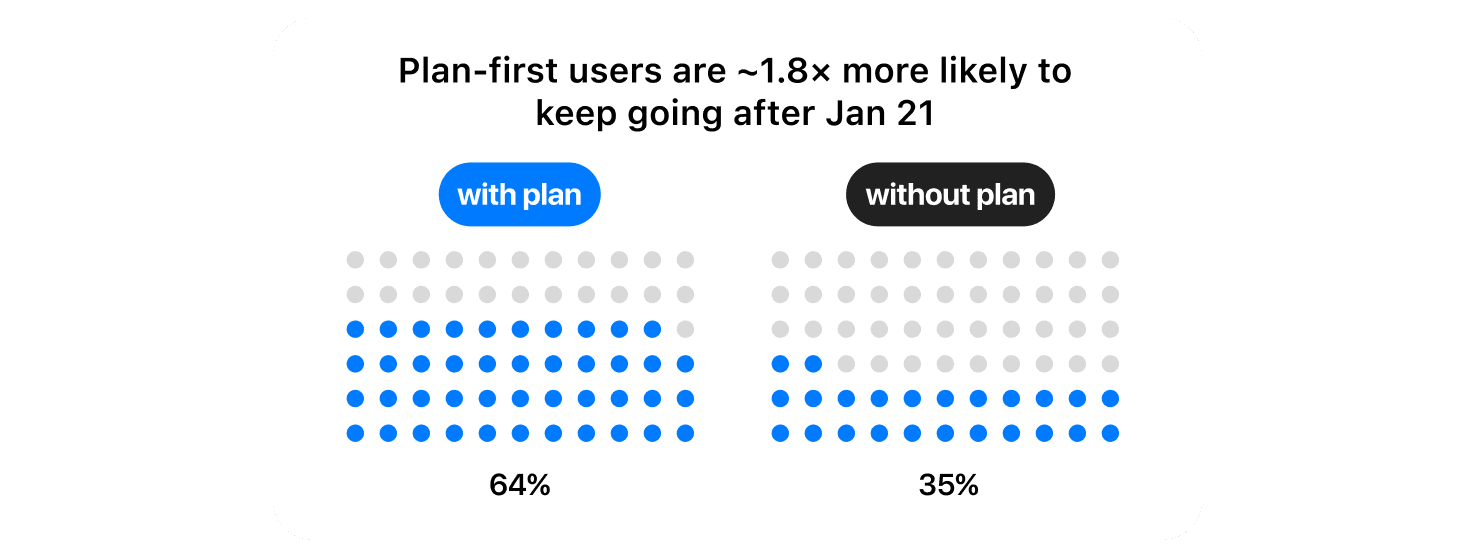
In our data, users who started their first workout as part of a structured plan were ~1.8× more likely to still be working out after Jan 21 than users who started with a standalone workout (“I’ll just pick something”).
- Plan-first: 64%
- Standalone-first: 35%
This doesn’t prove “plans cause success” (people self-select, and motivation differs). But it’s a strong, consistent pattern: the first step matters, and structure helps people keep moving when motivation fades.
2) Bigger goals don’t motivate better — they often backfire
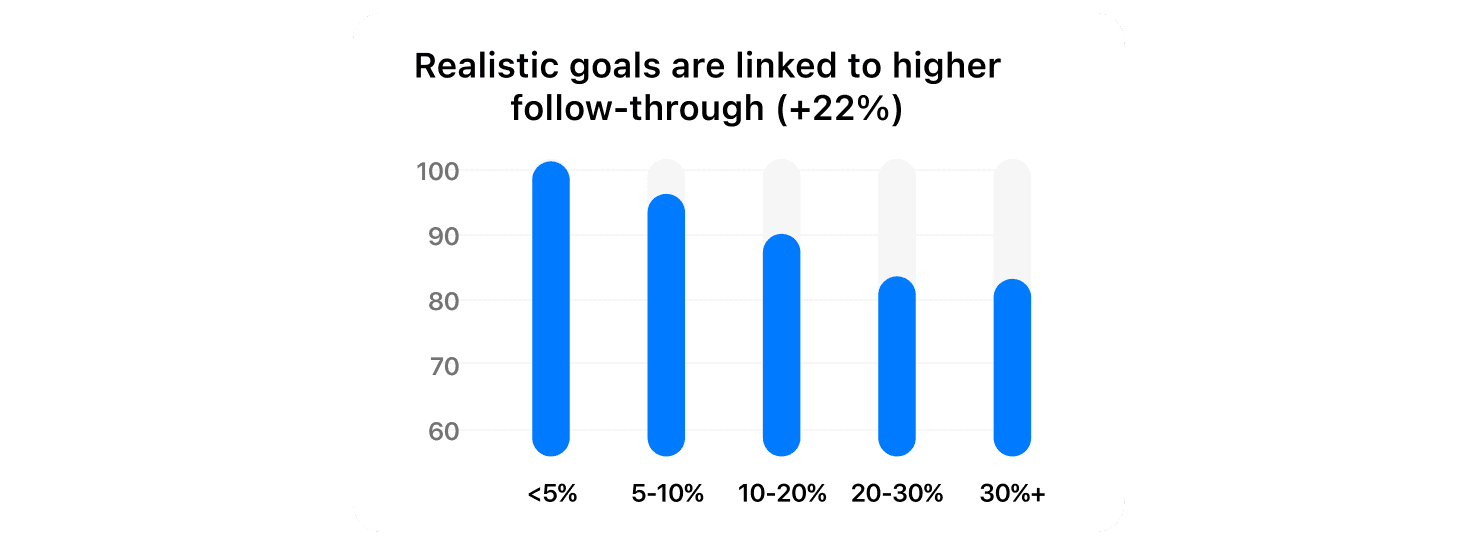
Among users who set a weight-loss goal, those aiming for a smaller, more achievable change (e.g., <5%) had 22% higher follow-through after Jan 21 than users aiming for a large jump (e.g., 20%+).
Again: not destiny, not moral failure — just a pattern. When the goal feels too far away, it’s harder to keep showing up.
Bonus: how this looks across countries?
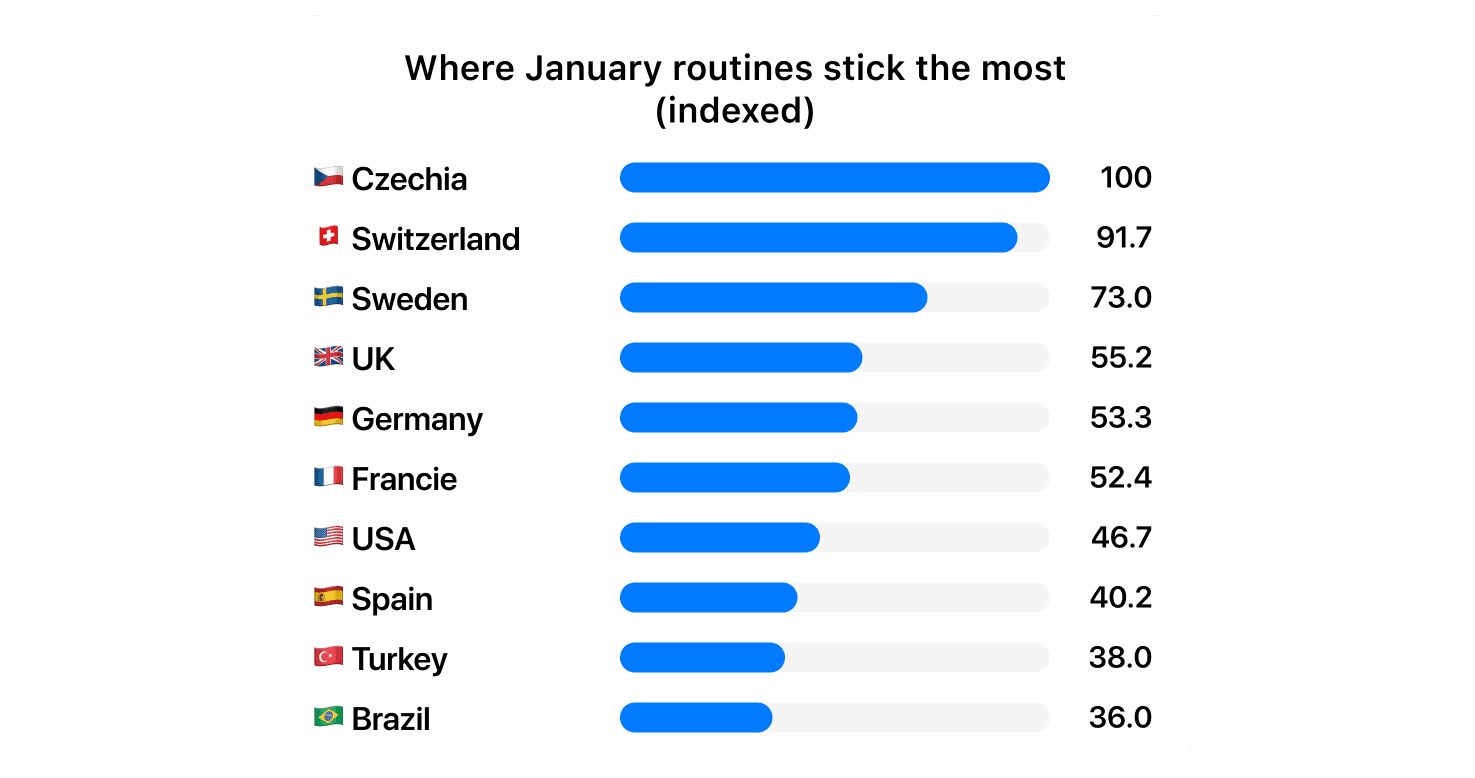
One more lens: where do people actually stick with January the most? Using the same “still working out after Jan 21” definition and normalizing the #1 country to 100, we see meaningful cross-country differences in follow-through (based on ~270,000 users). Switzerland lands at 91.7, Sweden 73.0, the UK 55.2, Germany 53.3, France 52.4, the USA 46.7, Spain 40.2, Turkey 38.0, and Brazil 36.0. This is an index (not a league table of “who’s fitter”)—it’s influenced by user mix and local context—but the headline stays consistent everywhere: structure beats willpower.
A better alternative to “Quitter’s Day”: Reset Day
A lot of fitness brands lean into Quitter’s Day with campaigns and challenges. We like the intent (help people keep going). We just think the framing should be kinder and more useful.
So here’s a simple “Reset Day” playbook you can use today:
Step 1: Pick a plan (not a mood)
- Choose a plan with a clear schedule.
- If you’re inconsistent, pick fewer days — 2–3/week beats 0/week.
- If the plan feels intimidating, lower the intensity or shorten the workouts.
Step 2: Downshift the goal until it’s realistic
If your goal is huge, don’t abandon it — sequence it:
- Phase 1 (4–6 weeks): consistency and energy
- Phase 2: progressive overload / more volume
- Phase 3: bigger body composition changes
Step 3: Set a “minimum viable workout”
Your worst-day plan should be explicit:
- 10 minutes counts.
- Mobility counts.
- A short walk counts.
This is how you keep the chain unbroken psychologically — without requiring perfection physically.
Step 4: Design for “getting back on track”
Instead of “I failed,” your rule is:
- Miss once → do the minimum tomorrow.
- Miss twice → do the minimum today.
Not because streaks are magic. Because returning quickly stops the story from becoming “I’m not that person.”
If you’re behind, you’re not late
If today feels like a punchline, ignore the label.
The only thing that matters is this:
Make the next workout easier to start than it is to avoid.
That’s how routines survive January – and how they last long enough to become part of real life.